The iconographic themes on the sanctuary arches of Byzantine temples (AD 324-1204)
Disclaimer
The article below was originally written as an undergraduate assignment for the Greek Open University in 2004, during a period when the author’s academic skills were still developing. Although it does not match later examples of the author’s work, it is written thoroughly and contains useful information for students and other readers with non-specialised knowledge.
The original assignment, on which this article is based, was written in Greek and intended for specialised academic art historians. Despite the author’s best efforts to present this essay as clearly as possible, some points and arguments may still be lost in translation.
The bibliography used for this article is limited, consistent with the requirements of an undergraduate assignment of this level. No additional bibliography was added during the translation of the work into English because of time and access limitations. The original bibliography was studied from translated Greek copies; therefore, the page numbers in the citations below correspond to those copies, not to the original volumes.
In a series of other articles, the author has already expressed his objections and complaints about how the publishing industry abuses and exaggerates matters related to the intellectual property rights of photographed artefacts. For this online article, the author decided to follow the rules and omitted any photographs that could attract negative attention.
The point the author is trying to make is simple: no matter how much effort authors and publishers put into restricting the circulation of photographs of archaeological artefacts, websites will always circulate such material for free and beyond their reach.
Introduction
The aim of this short study is to examine how iconographic themes on the sanctuary arches of Byzantine temples developed from the 4th to the early 13th century AD. Its central argument is that this development followed three distinct phases—the Early Byzantine, Iconoclast, and Middle Byzantine periods—each shaped by the theological and political views of its time, and each marked by a different dominant sanctuary-arch theme.
The Early Byzantine period (AD 324-726)
During the Early Byzantine period, three main iconographic themes appeared on the sanctuary arches of Christian temples. First, there were representations of Jesus Christ inspired by abstracts from the Old and New Testaments, St. John’s Revelation, and the Orthodox Divine Liturgy (Albani 1999a, 83). Two characteristic examples are the Triumphant Christ from the temple of Osios David in Thessaloniki (Albani 1999, 83-4; Lowden 1999, 168) and the Transfiguration of Christ Saviour from St. Catharine’s Monastery at the Sinai Peninsula (Lowden 1999, 74). Second, there were representations of the cross, the holiest symbol of the Christian faith. A characteristic example is the mosaic at the Basilica of Sant’Apollinare in Classe, in Ravenna, which combines a cross with a symbolical representation of the Transfiguration of Jesus Christ (Lowden 1999, 82-3). Third, there were representations of the Vrephokratoussa (baby-holding) Theotokos (carrier of God). Characteristic examples are found at the Basilica of Panagia Kanakaria in Lythragomi, Cyprus (Albani 1999a, 84) and at the Euphrasian Basilica (Eufrazijeva bazilika) at Poreč, Croatia, also known as the Cathedral Basilica of the Assumption of Mary (Lowden 1999, 141).
The mosaic of the Transfiguration of Christ Saviour from the sanctuary arch of St. Catharine’s Basilica at the Sinai Peninsula dates to the 6th century AD (Panselenou 2002, 88). In some temples, such as this one, sanctuary arches were almost exclusively decorated with mosaic tiles (Almpani 1999a, 82). This technique aimed to emphasise the holiness of this specific area of the temple through elaborate, expensive decoration.
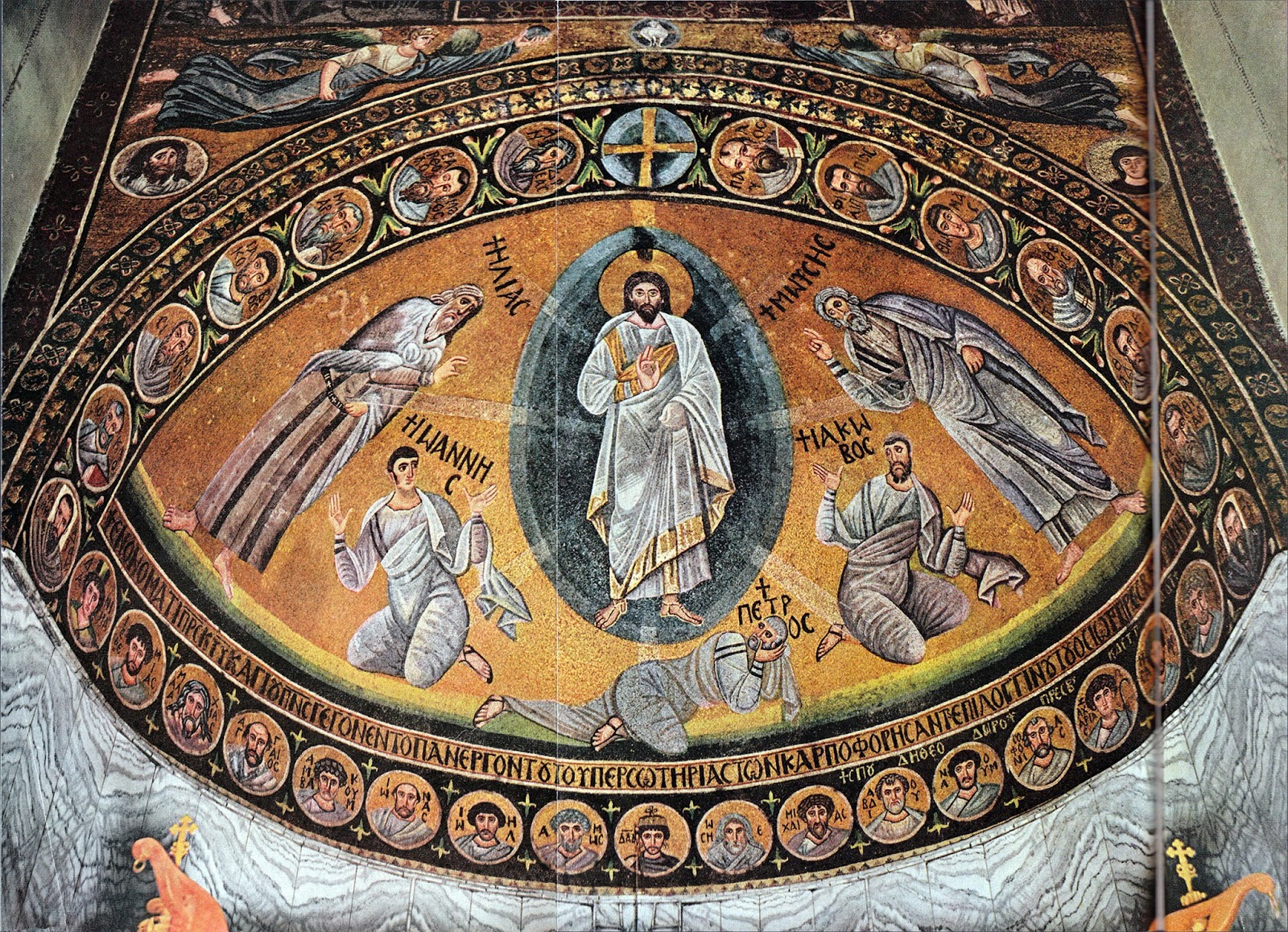
In the above mosaic, Jesus Christ is represented frontally, suspended in the centre. He is wearing a halo and a white-and-golden robe. His arm extends forward at chest height, and he is blessing the viewers. Eight bright light beams are symmetrically diffused in different directions. Christ is surrounded by a light-blue ovoid frame, and the background is coloured with golden pixels. The use of bright colours to represent depth, volume, and the expressiveness of the forms carries the viewer into the transcendent world of the divine (Panselenou 2002, 107). Around the body of Jesus Christ are five figures symmetrically arranged and fully represented. These are Prophet Elijah; Moses, whose right arm is extended in a blessing gesture; Christ’s disciples John and James, who are kneeling in a praying posture; and, at the bottom of the mosaic, Apostle Peter, who is represented almost lying down with his right hand supporting his head. The clothes of the five figures are neat with rich folds. On the curve of the arch, there are twelve representations of the disciples of Christ. Six are arranged on the left side, and another six on the right, while in the middle of the arch, directly above the head of Jesus Christ, there is a representation of a golden cross. The edge of the semi-circular base of the architectural quarter-sphere is decorated with nineteen holy figures of the Christian tradition.
The lack of a third dimension, the images' immobility and frontality, and the abstract representation of the background are all artistic elements of late antiquity. Byzantine iconography employed these elements to represent the transcendent character of Christian art (Albani 1999b, 21-6).
The Iconoclasm period (AD 726-843)
During the Iconoclasm period, the production of icons and other representations of divine figures was banned under imperial orders. According to contemporary testimonies, the iconographic themes of this period were aniconic and included representations of trees, plants, and animals. In the sanctuary arches of temples, the main decorative theme was the cross, which had already been in use before the Iconoclasm period (Albani 1999a, 97).
The reasons for the Iconoclasm debate were equally political and theological. They were first associated with the dangers posed by the Islamic expansion from the East and, second, with the ecclesiastical conflicts over theological matters during the Ecumenical Councils of that period (Lowden 1999, 147-8). The aniconic decoration of the temples was a disorienting solution to the ecclesiastical issues debated during the Ecumenical Councils. At the same time, it served as a political approach towards the Eastern nations that followed monophysite heresies and towards Arab Muslims (Panselenou 2002, 131-2).
A typical example of a temple with aniconic decoration dating to the Iconoclasm period is Hagia Irene at Constantinople. The representation of the cross on the arch above the sacred step of the temple dates after AD 740 (Lowden 1999, 158-9). The arch has suffered great damage; however, the extraordinarily neat representation of a large cross is still visible. The edges of the cross end in twin angular points, each intersecting with an ovoid ring. The cross is placed on a stepped triangular base, and the monochrome background is totally aniconic.
https://wikivisually.com/wiki/Byzantine_Iconoclasm
The Middle Byzantine period (AD 843-2014)
During the Ecumenical Council of Nicaea in AD 787, which was summoned by the icon-supporter Empress Irene the Athenian, ecclesiastical circles of the time established distinctions between casual artwork and the correct representations expected in ecclesiastical art. The iconography of the time often allowed artists to modify some traditional artistic conventions; however, the artwork still needed to be precise and recognisable to viewers. After AD 787, the content of ecclesiastic art became strictly regulated (Lowden 1999, 175-6). In AD 843, the preconditions established in ecclesiastical art, including the ban on iconic representations, were completely abandoned; Christians were now allowed to venerate the divine images depicted on icons without fear (Albani 1999a, 100). Furthermore, during the 9th century, the Islamic expansion stopped, and new events, such as the ‘Renaissance of the Macedonian Dynasty’ (867-1081) and the Christianisation of the Bulgarians (AD 864) and the Russians (AD 988/9), generated a boost in Christian iconography (Panselenou 2002, 135-7).
The first appearance of a new type of temple during the 9th and 10th centuries AD, the so-called cross-in-square or crossed-domed temple, coincided with the establishment of a decoration plan, which demanded the representation of specific forms in specific locations inside the temple (Panselenou 2002, 138-9). From that period onwards, the niche of the sanctuary’s arch hosted the representation of the Holy Mother of God holding the Divine Infant, which is commonly known as the Vrephokratoussa Theotokos (Albani 1999a, 100; Panselenou 2002, 141). The representation of Holy Mary on the quarter-sphere of the sanctuary’s arch, which is one of the most visible sections of a Christian temple, was probably due to the important role the Panagia Theotokos played in the development of Byzantine thought. A characteristic example was the belief that the Avar siege of Constantinople in AD 626 failed after the intervention of the Holy Mary (Panselenou 2002, 146).
http://onassisusa.intelligentlearningmedia.com/blogos/?p=372
A typical example of the Vrephokratoussa Theotokos comes from Hagia Sophia in Thessaloniki, dating to AD 787-797 (Lowden 1999, 161). The Theotokos is depicted in a flat, static manner. Facial expressions are absent, and the scene carries no emotional charge. Such elements are typical of Middle Byzantine iconography. a halo on her head; her face is rounded, and her eyes are distinctively large. The Divine Infant is represented in the arms of the Theotokos, wearing a neat child’s robe and a golden halo on the head. The Theotokos is wearing a long, dark-coloured, richly-folded robe that reaches the ground and covers the entire throne on which she sits; the only visible element of the throne is a red cushion. On the cylindrical ceiling of the sanctuary, there appears a circular frame with a cross surrounded by eight pairs of stars.
In relation to the representation’s style, the Theotokos sits completely still. The mosaic's background was created using a special technique in which the golden pixels were affixed to the wall at an angle. This way, the pixels reflect light back to viewers, creating the impression of a transcendent image (Albani 1999a, 104). The mosaic of the Vrephokratoussa Theotokos has overlaid an earlier representation of the cross, dating to the Iconoclasm period (Lowden 1999, 160-1). The sanctuary arches of the Early Byzantine period primarily depicted images of Jesus Christ, inspired by the holy scriptures, as well as the cross and the Panagia Theotokos. Iconoclasm introduced changes in the representation of sacred forms. For a series of theological reasons (e.g., differences among the Ecumenical Councils) and political reasons (e.g., a shift towards the Eastern territories after the Arab expansion), the Byzantine Emperors imposed aniconic decoration on Christian churches. This led to the plain cross becoming the dominant representation of the temple sanctuary arches. After the end of Iconoclasm in AD 843 and the ‘Renaissance of the Macedonian Dynasty’, the representation of the Vrephokratoussa Theotokos became established as the sole decorative theme for the sanctuary arches. It was also the period during which a uniform canon was introduced to maintain a hierarchy of religious themes in ecclesiastical decoration, a system that remains in use today.
Bibliography
Albani, J., 1999a, ‘Visual works of the Byzantine period’, in Papagiannopoulou, A. (ed.) Arts 1: Greek Representational Arts. Review of Greek Architecture and Urban Planning, Volume 2, Byzantine and post-Byzantine art, Patra: Greek Open University.
Albani, J., 1999b, ‘Introduction to Byzantine art’, in Papagiannopoulou, A. (ed.) Arts 1: Greek Representational Arts. Review of Greek Architecture and Urban Planning, Volume 2, Byzantine and post-Byzantine art, Patra: Greek Open University.
Lowden, J., 1999, Early Christian and Byzantine Art, second edition, translated by M. Agelidou, Athens: Kastaniotis.
Panselenou, N., 2002, Byzantine Painting. Byzantine Society and its Icons, Athens: Kastaniotis.