Examples of Greek Bronze Age art
Disclaimer
The article below was originally written as an undergraduate assignment for the Greek Open University in 2004, during a period when the author’s academic skills were still developing. Although it does not match later examples of the author’s work, it is thorough and contains useful information for students and other readers with non-specialised knowledge; therefore, it has been included on this website.
The reader should note that the original assignment on which this article is based was written in Greek and intended for specialised academic art historians. Despite the author’s best efforts to present the essay clearly, some points and arguments may still be lost in translation. Readers are advised to consult the web for additional information on any unknown words or specialised vocabulary.
The author admits that the bibliography used for this article is limited, consistent with the requirements of an undergraduate assignment of this level. No additional bibliography was included during the translation of the work into English due to time and access limitations. The original bibliography was studied from translated Greek copies; therefore, the page numbers in the citations below match those copies, not the original volumes.
In a series of other articles, the author has already expressed his objections and complaints about how the publishing industry abuses and exaggerates matters related to the intellectual property rights of photographed artefacts. For this online article, the author decided to play by the book and did not include any photographs that could attract negative attention. Still, the article includes links to websites supporting the visual representation of the artefacts mentioned in this study.
The point the author is trying to make is simple: no matter how much effort authors and publishers put into restricting the circulation of photographs of archaeological artefacts, there will always be websites that circulate such material for free and beyond their reach. What they are trying to achieve is pointless.
The Bronze Age man and nature
This short article presents visual examples of the relationship between Bronze Age artisans and nature, as expressed through different forms of artistic creation in Prehistoric Greece. It discusses three artworks from metalwork, pottery, and wall painting, and explores the relationships among three major civilisations that flourished in the Aegean during the later Bronze Age: Mycenaean, Cycladic, and Minoan.
Metalworking
A characteristic example of advanced metalworking from mainland Greece was the inlaid daggers. The artefact examined in this section was recovered from Shaft Tomb 5 of Grave Circle A at Mycenae and is nowadays exhibited at the National Archaeological Museum of Athens.

The blade is 47mm wide and is decorated with representations of felines hunting birds in a Nilotic scenery (Hood 1993, 221). The term Nilotic refers to a landscape with vegetation identical to that growing along the banks of the River Nile (Papagiannopoulou 1999, 134). On this specific dagger, such representations resemble papyrus plants (Hood 1993, 218).
Interpretations of this artefact's chronological and cultural context vary. Papagiannopoulou (1999, 86-7) suggests that the dagger is of Mycenaean manufacture and dates to the beginning of the Late Bronze Age, roughly around the 16th century BC. By contrast, Hood (1993, 220) suggests that the artefact was produced in Crete rather than on the Mainland, and dates it to the Late Minoan Ia period (LMIa), roughly between 1550 and 1500 BC. Hood (1993, 220) argues that such artefacts are typical examples of Minoan art, despite their widespread circulation on the Mainland and their complete absence in Crete. In his view, this paradox in their distribution is a pure coincidence.
The decoration of the dagger has been produced by infilling of various precious metals on top of the blade, which were later coated with Niello. This decorative technique appears to have been introduced from Syria (Hood 1993, 220). More specifically, thin sheets from precious metals, such as silver, gold and copper, were hammered within concavities that had been previously engraved on the exterior of the dagger’s blade. Then, the entire decorated exterior was coated with Niello, a mixture of copper, silver, lead, and sulphur that gives off a distinctive metallic gloss. The different colours of the representations were achieved by combinations of different sheets of precious metals (Papagiannopoulou 1999, 85).
The left side of the blade shows a feline attacking water birds moving in the opposite direction. This scene, divided into two levels, suggests a curving water stream and papyrus plants at different depths. The feline, which traps the two water birds with its claws and teeth, underscores the brutality of the hunting scene.
In general, all animals are depicted statically. The dominant colour is yellow from the gold, followed by silver and orange from the glossed copper. The details on the animals’ bodies were probably engraved with a thin chisel.
Decorated pottery
Bronze Age artisans who decorated ceramic vessels from Crete showed a distinct preference for themes associated with nature. A typical example of Cretan Bronze Age pottery with naturalistic decoration is presented below.
https://i.pinimg.com/736x/00/23/0d/00230d65acccd04a49c280db209371bf.jpg

The vessel is a neckless amphora or short-handled pithos, 545mm tall, which was recovered from the Minoan Palace of Knossos and is nowadays exhibited at the Ashmolean Museum in Oxford. It dates to the Middle Minoan period, though its exact chronology is debated. Arthur Evans placed it at the end of Middle Minoan II (MMII) while Hood (1993, 42-3) argued that it must be later, dating to the Middle Minoan IIIa (MMIIIa), roughly around 1600 BC.
The pithos is a domestic pot produced on the potter’s wheel. It is a relatively large vessel designed to store various agricultural products. The potter’s wheel was introduced in Crete during the Middle Minoan period and played an important role in the development of the Kamara Wares (Hood 1993, 42-3; Papagiannopoulou 1999, 56-67).
The Kamara Wares were characterised by their elaborate painted decoration, which combined multi-coloured motifs and a glossy black font (Papagiannopoulou 1997, 57). This specific pithos is decorated with white palm trees, the details of which are emphasised with red. The palm trees are drawn on the same level; they appear still, and there is no representation of depth. The central palm tree stands slightly higher than the others. Its rich, dense foliage is likely to suggest a warm-season representation. The top foliage of the tree appears in distinct curves, almost as two circles on either side of the trunk, symmetric in position and size. All trunks are rooted into the earth, which is painted on the lower exterior of the vessel.
The vessel’s background is black and glossy, causing a distinct visual contrast with the bright colours of the plants (Hood 1993, 42). Such visual effects characterised the broader Kamara style, which was abandoned at Knossos after an earthquake circa 1700 BC. It was replaced by the Floral style, which produced the exact opposite effect: black glossy motifs on a bright-coloured background (Papagiannopoulou 1999, 57).
Usually, most Kamara Wares are defined as ‘eggshell’ due to their thin walls (Papagiannopoulou 1999, 66); however, the pithos discussed in this section is highly unlikely to be eggshell. Its size and intended use required a denser, heavier fabric that would form strong, thick walls.
Wall painting
Wall painting was the most typical form of Bronze Age art, which focused on the representation of nature. A characteristic example is the so-called ‘Spring Fresco’, recovered at the settlement of Akrotiri on the island of Thera and now exhibited at the National Archaeological Museum of Athens.
http://www.travel-to-santorini.com/pages_images/123.jpg
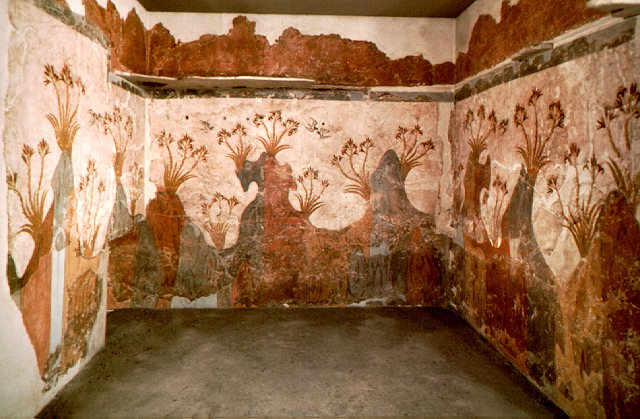
The fresco dates to the Late Minoan Ia period, around 1550 BC, and, despite its Cycladic origin, its Minoan inspirations are evident. According to interpretations of the archaeological evidence from Akrotiri, a previous earthquake, a generation earlier than the main earthquake, caused the final abandonment of the settlement circa 1500 BC. This fresco is likely to have stood on a reconstructed wall, dating to the period between the two earthquakes (Hood 1993, 64-5).
The fresco is dominated by red, yellow and light blue colours. The artist intended to represent a rocky scenery, possibly the island of Thera itself, by incorporating a variety of shades. The picture shows three large, irregularly shaped rocks, on top of which red lilies with yellow stems grow. The lilies are growing in sets of three. The painting is characterised by intense mobility. It appears that the wind is shaking the plants' stems in different directions, and on the white background of the picture, which represents the sky, three flying swallows are shown. The birds' movement is obvious: two are meeting face to face as if courting, and their positions imply rotation in the air. On the right side of the fresco, there is a third swallow with its wings bent and its head facing upwards, giving the impression that it is about to fly vertically in the sky (Papagiannopoulou 1999, 102-3). The scenery, which consists of blooming lilies and flirting birds, suggests the coming of spring; hence, the name attributed to the fresco today.
Interpretations of this fresco vary. Papagiannopoulou (1999, 103) suggests that it was probably part of the broader decoration of a worship space and that it bears religious significance. If the room where the fresco was found was indeed used for religious worship, its image might have been linked to a celebration or ceremony marking the coming of spring. If this is the case, there is a clear correlation between the representation and the functionality of the space in which it was placed. Furthermore, Papagiannopoulou (1999, 103) suggests that the recovery of a bronze sickle and several cooking vessels from the same room strengthens the likelihood that the space was probably associated with a religious cult.
By contrast, Hood (1993, 65) suggests that the sacred/religious spaces of the houses at Akrotiri were isolated and located on the top floors of the buildings. Similar religious facilities have been found in the houses at Knossos, Crete. The room in which the ‘Spring Fresco’ was discovered was a small enclosed space on the ground floor of the building; therefore, it is highly unlikely to have been associated with a religious space. Instead, Hood (1993, 65) ties the fresco to everyday decorative themes that were popular in the Bronze Age Cyclades and were not associated with any form of religious cult.
The association between the ‘Spring Fresco’ and the wall paintings of Minoan Crete is evident to both scholars. Hood (1993, 65-6) points out that there are common features between the lilies represented on the Thera fresco and those from the frescoes of Agia Triada in Crete, Trianta in Rhodes and the South-East House at Knossos. The representation of lilies in sets of three was already known in Minoan Crete, even during earlier periods. More specifically, sets of three lilies have been found on decorated pottery from Knossos, which Evans dated to the Middle Minoan III period (MMIII) (Hood 1993, 64-5).
Bibliography
Hood, S., 1993, The Arts in Prehistoric Greece, translated by Pantelidou, M. & Xenos, Th., Athens: Papadimas.
Papagiannopoulou, A., 1999, ‘Prehistoric times’, in Papagiannopoulou, A. (ed.), The Arts I: Greek Representational Arts, Overview of Greek Architecture and Urban Planning, Volume 1, Prehistoric and Classical Art, Patra: Greek Open University.